Cooking Isn’t a Chore—But We’ve Started Treating It Like One
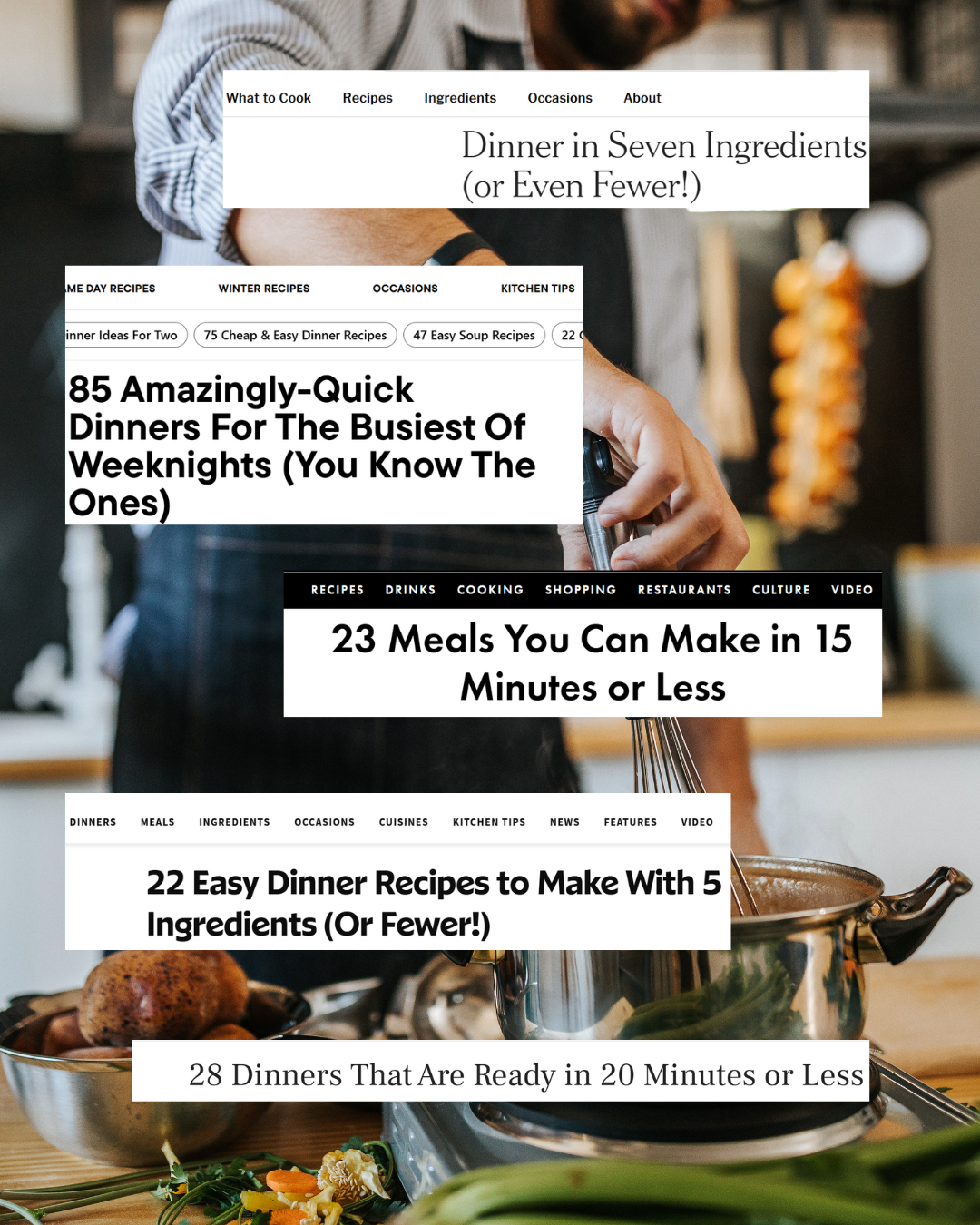
As a dietitian who works individually with clients, as well as more broadly in the nutrition media landscape, something I’ve noticed recently, in all facets of my work, is that we as a whole have decided that cooking should be fast. Not just easy—fast.
I see it everywhere in food media, and lately, uncomfortably, I’ve been seeing it in myself. Which feels ironic, considering I quite literally changed careers to work in nutrition and food. Cooking was supposed to be my thing, my hobby, my joy. The grounding ritual I told myself I’d always make time for. And yet, here I am, falling for the same language as everyone else: quick; minimal; ten minutes or less; three ingredients; one pan, ideally no cleanup, and absolutely no emotional attachment.
And truly, I get it. Time is limited. Energy is finite. Some days, the thought of washing more than one pot is enough to make dinner feel like a personal attack. Convenience matters—especially when life is busy, money is tight, or you’re just tired of making decisions.
But at some point, convenience stopped being a tool and became the entire point.
When Speed Becomes the Personality
Right now, cooking is framed as something to get through as quickly and efficiently as possible. The faster you’re done, the less time you have to spend doing it. The goal isn’t enjoyment, curiosity, or even nourishment—it’s completion. And when that’s the dominant narrative, cooking stops feeling like something you do and starts feeling like an annoying, nagging, time-sucking task.
We rarely talk about cooking as a skill you build over time. Or something that can be imperfect and still deeply satisfying. Or something that creates connection—to culture, to other people, to yourself. Instead, we talk about it like a chore that should take up as little space in your life as humanly possible. That framing seeps in, whether we notice it or not.
Why This Actually Matters (Yes, Even Nutritionally)
As a dietitian, I don’t see people struggle with nutrition because they don’t care enough or aren’t trying hard enough. I see them struggle because cooking feels stressful, overwhelming, rushed, and even vaguely disappointing. When everything is about speed, variety disappears. Confidence disappears. People stick to the same few meals, the same few flavors, the same safe foods—not because they want to, but because experimenting feels like too much work.
And I don’t just see this in “people.” I see this in myself too. Reflecting on the last few weeks of cooking, I can tell you that most of my meals have been the same few recipes that I’m currently enjoying on rotation. Although there’s nothing wrong with this, it completely strips cooking of the joy that it used to evoke (at least that it used to evoke for me).
Nutrition isn’t just nutrients on a plate. It’s satisfaction. It’s enjoyment. It’s connection. It’s feeling capable in your own kitchen. When those things are missing, nourishment suffers too. And by nourishment, I don’t just mean eating “healthy.” I mean curiosity, pleasure, and the little spark that makes cooking feel worth it.
This Is Not a Manifesto Against Convenience
To be clear: not every meal needs to be a production. I simplify meals constantly. I rely on shortcuts. I repeat dinners. I choose ease when I need it—and sometimes when I just want it. When I was younger, I was definitely more apt to commit to a complicated recipe on any random week night just for the fun of trying something new. And I have to wonder why that’s gone away. Is it because life has gotten busier? Is it because social media has taken over and we all feel some sort of pull to get back to scrolling as quickly as possible? Or is it because the media has framed cooking as a convenient means to an end?
Convenience isn’t the enemy. But when every message about food centers on shortcuts, we start to absorb a bigger idea: that cooking—and by extension, feeding ourselves—isn’t worth time, attention, or care. That it should be minimized, optimized, or checked off as quickly as possible. And that? That’s when things start to feel off.
Maybe the Problem Isn’t Cooking—It’s How We Talk About It
What if cooking didn’t always have to be faster? What if sometimes it was allowed to take a little longer, be a little messier, require a second pot or pan. What if it wasn’t about doing the least, but about doing something that actually felt good? Cooking doesn’t need to be precious or performative to be meaningful. It just needs room to be human. To be learned slowly. To be imperfect. To support nourishment in ways that go beyond macros and minutes. That’s the version of cooking I’m interested in reclaiming.